
I’ve been working through Exodus 35–40, and I can’t stop thinking about something.
God didn’t need a tabernacle.
He was God in Egypt. He was God in the wilderness. He was God when Abraham stacked stones and called it an altar. He wasn’t waiting on gold and silver and linen curtains in order to dwell with His people.
And yet… He gave them the instructions anyway.
The precision.
The craftsmanship.
The teamwork.
The beauty.
It wasn’t as if God suddenly required a structure in order to exist. He had always been present. The tabernacle wasn’t about meeting a need in God — it was about shaping something in them.
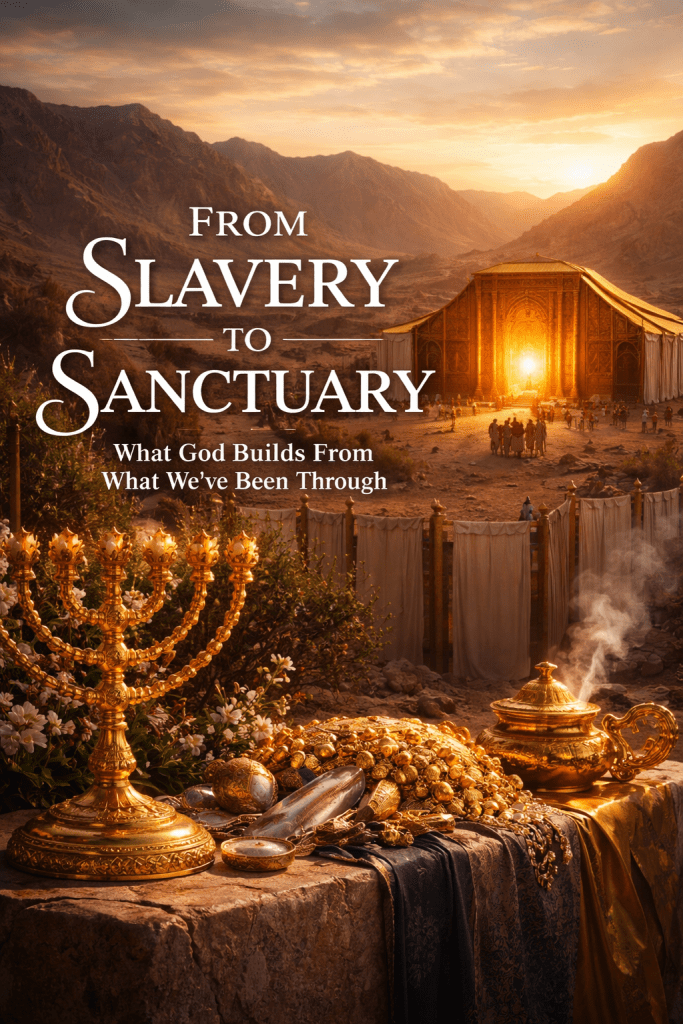
One thing that stands out to me is where the materials came from. All that gold and silver and fine linen? It came out of Egypt. It came out of their captivity. The very place of their oppression became the source of their offering.
God didn’t erase their past. He repurposed it. He redeemed it.
The gold and other metals were literally melted down and made into something brand new.
What had once been tied to slavery was now woven into worship. What had once symbolized bondage became a visible reminder of redemption. Every thread and clasp quietly testified: This is where we’ve been. This is what God brought us out of.
And then there’s the skill.
Over and over, Scripture says God stirred the hearts of skilled craftsmen — men and women filled with ability, artistry, and wisdom. But where did they learn that? In Egypt. In slavery.
Their training ground was suffering.
God did not waste it.
He took what they learned under harsh masters and used it to build something sacred. Their years of forced labor became the very foundation of their contribution to God’s dwelling place.
There is something deeply redemptive about that.
He was also teaching them how to be a nation.
This wasn’t just construction. It was formation.
They had to work together. They had to give freely. They had to trust leadership. They had to bring their best. And at one point, they were giving so generously that Moses had to restrain them because there was more than enough for the work.
More than enough.
What could happen in our own communities if we put God first like that? If we offered our skills, our resources, our experiences — even the painful ones — and said, “Use this”?
And then there’s the beauty.
Almond blossoms carved into the lampstand. Intricate designs that echo creation itself. God didn’t need beauty — but He chose it. The artwork reflects the natural world He made.
It reminds me that God loves what He created. He loves detail. He loves craftsmanship. He loves beauty. And if He cares that much about carved almond buds in a lampstand, how much more does He care about us?
Now we are the temple — not built of gold and acacia wood, but living and breathing. And maybe the invitation is the same.
God still doesn’t need a room.
He doesn’t need a chair set aside in the corner of our house. He doesn’t need a reserved time slot on our calendar. He doesn’t need us to build Him anything physical.
But He invites us to make space anyway.
He invites us to build room for His presence in our daily lives — to intentionally put Him first, to center our decisions around Him, to create rhythms where He is not an afterthought but right there up front.
Not because He lacks anything, but because He loves us.
The tabernacle wasn’t about supplying something God was missing. It was about teaching His people how to live with Him at the center.
And maybe that’s still the lesson.
What has God brought you out of that He wants to repurpose?
What skills were formed in seasons you would never choose — that He now wants to redeem?
What would it look like to bring your “gold” freely?
And where, in your everyday life, are you intentionally building space for His presence?
Exodus 35–40 isn’t just about constructing a sanctuary.
It’s about a God who forms a people.
And it’s about a God who still invites us — gently and lovingly — to make room for Him.

 The Me I was Meant to be